←
All field notes
Engineering
6
min read
Why we cool with air, not water
Hall A has no chillers and no cooling towers. Outside air at 69° N does the work and uses zero litres of water. Here is how, and where it gets hard.

Ravi Menon
Head of Engineering
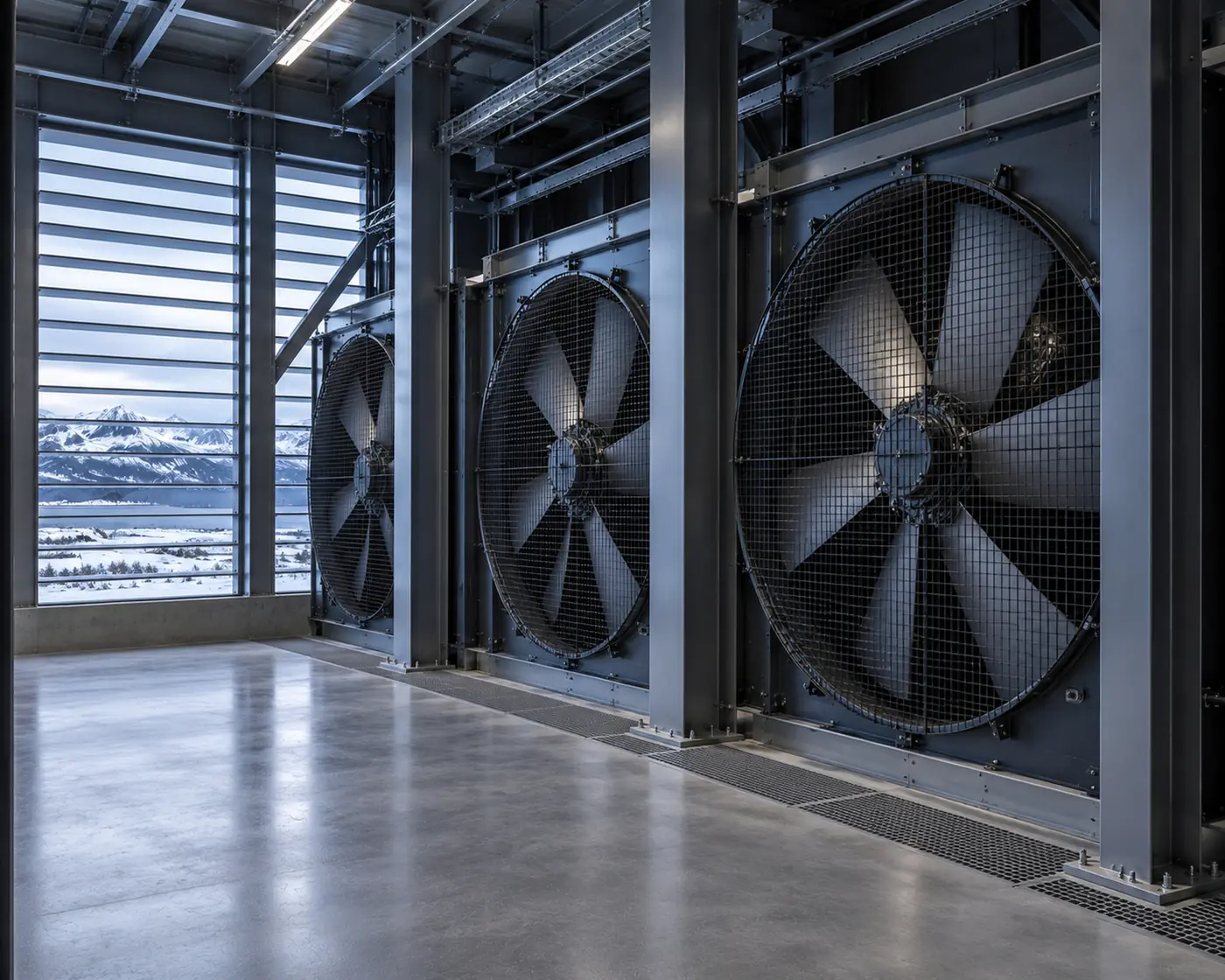
Hall A, Narvik · 68.4° N
Photo: Nordlys
Most GPU halls are built around water: chilled loops, evaporative towers and, in the newest builds, liquid running straight to the cold plate. When we drew Hall A in 2024 we started from a different question. What if the climate is the cooling plant?
The climate is the chiller
Narvik sits at 68.4° N, on a fjord that never freezes but an air mass that mostly does. For about 8,400 hours of a typical year, outside air is colder than the 24 °C we feed the cold aisle. We filter it, blend it with warm exhaust to stay above the dew point, and push it through the racks with slow, large fans. There is no compressor anywhere in the loop.
The result is a twelve-month PUE of 1.08. Almost every watt we draw from the grid reaches a GPU, and every one of those watts comes from hydro in the valleys behind the town.
Why not water
Water cooling is not wrong. Direct-to-chip liquid is the right answer for very dense racks, and we will run it for B300 pods from Q1 2027. But evaporative cooling, the default in most of the world, consumes water to reject heat. A 20 MW hall can evaporate 300,000 litres on a warm day. In a town of 22,000 people, that is not a trade we want to make.
The cheapest litre of water is the one you never pump. At 69° N the air is already cold enough.
Air also fails gracefully. A pump failure in a liquid loop is an incident within seconds; a fan failure in Hall A is a ticket. Every row runs N+2 fans, and the thermal mass of the aisle gives operators minutes, not seconds.

Where it gets hard
Cold air is not free of problems. Three took us the longest to solve:
Frost. At −30 °C the intake louvres ice over. We recirculate exhaust to hold them at +2 °C, which costs about 0.4% of fan power.
Dry air. Arctic winter air drops below 15% relative humidity. Instead of humidifying, we ground everything: conductive floors, bonded racks, wrist straps at every door.
Snow. Drifting snow finds every gap. Intakes face the fjord, two metres above grade, behind a baffle wall that turns the air twice.
Summer is the other edge. On the warmest day of 2026, 27 July, outside air reached 26 °C for four hours. Inlet temperature rose to 27 °C, inside the ASHRAE A1 envelope, and no job was throttled.
What it means for your run
For customers the cooling design shows up in two places: the rate and the reliability. Power and cooling are a fixed part of every GPU-hour, so there is no seasonal surcharge and no water levy. And because the hall runs cool all year, H200s hold boost clocks longer. On a 1,024-GPU Tensorfield run in August, throughput per GPU was 3.1% higher than the same job in a warm-climate region.
If you want to feel it for yourself, the hall is open for visits every second Tuesday. Book a visit to Narvik, and bring a jacket.
Field notes · Hall A, Narvik


Run on Arctic air and hydro from $1.46 per GPU-hour. An engineer replies within one working day.